| Post Reply | RetroFed Forum Forum Index » UBI |
| Author | Message | ||
|---|---|---|---|
|
roastpotatothief
lemmy.ml
roastpotatothief@lemmy.ml Joined: 2020-11-26 |
Section 9 - Practicalities It would not be such a good idea to, in one day, change society so broadly. So there is a way to do it gradually and cautiously, in stages. Again, there are options:
This way UBI doesn't have to be truly universal, so you can keep the benefits, and keep any unforseen problems under control. Section 10 - Inflation UBI will definitely cause inflation. The first consequence of destitute people becoming not-destitute is inflation. People who now are struggling to survive (many students for example) will be able to afford proper food, clothes, haircuts, etc. This creates a demand and in the short term allows businesses to increase prices. In the long term it causes the local economy to grow - more hairdressers, clothes shops and cafes will open. Section 11 - Employment rates It can be argued that UBI either increases or decreases total employment rates. In fact there have been many global trials showing both results. Generally they have not been properly implemented though, so it's hard to extrapolate the results to real UBI as described here.
It's hard to predict. I think it's safe to say that the overall employment rate will not change much, but the employment landscape will change for the better. Section 12 - Redistribution In the example above, dole-earners and high-earners both pay about the same tax as before. The high earner pays slightly more tax - but he gets it back indirectly if he has adult dependents. But single high earners will lose income, and very low earners are getting much higher income than before. There are three ways to deal with this:
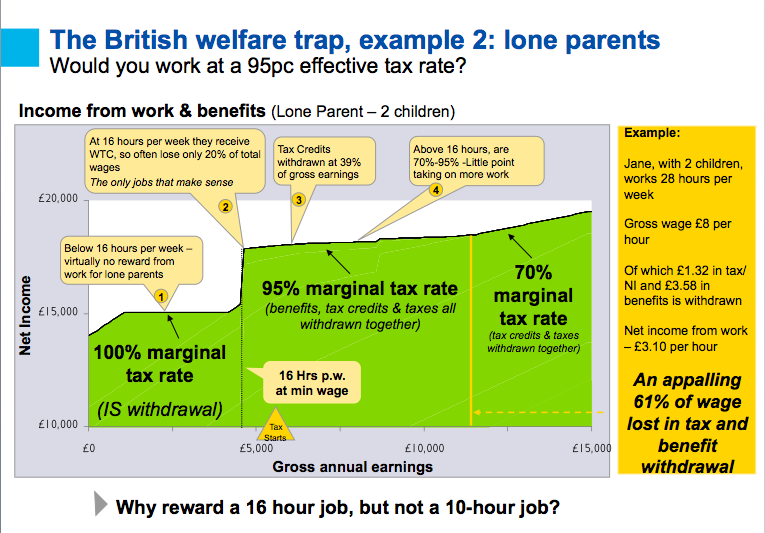
Options 2 and 3 mean that every type of worker has about the same income as before. But we have still achieved the goal of removing the welfare trap. It sounds unfair that low-earners must pay 50% tax - much more than high earners - but this is what they do today. Today, there is a hidden 50% tax on low earners. It is created by the interface between the welfare/tax systems. UBI (with option 3) just makes this explicit. Section 13 - Real welfare trap examples Of course legislators have thought the welfare trap before and tried to fix it. For example here and here where your income stays nearly the same no matter how much you work, which is effectively a 100% tax on the lowest earners. This increases complexity but does not actually solve anything. It creates smaller welfare traps which the poor need to navigate, to avoid being pushed further into poverty. Section 14 (TBD) Balancing the budget It would be useful to prove that UBI does not cost the government money, using calculations on real-world data. [extra money needed] = ([adult population] - [unemployed])*[dole payment] [extra money needed per employed] = [extra money needed] / [number of employed] [rate of the new flat income tax] = [extra money needed per employed] / [mean wage] The result is a 23% flat (non-progressive) tax. This is added to the existing taxes. So high earners pay a total of 63% marginal tax. This may sound high. Some say that too-high income taxes reduce total tax revenue and also economic productivity, because people have less incentive to work more and earn more money. Compare this to the existing situation, where low earners are effectively being charged more than 100% tax, which certainly leads to lower productivity and lower tax revenue, and is much worse. Also note that 63% is lower than the usual estimate for the optimal tax rate. TBD: A plot would be useful, showing how an individual's income would change. X-axis is income before tax. Y-axis is income after tax. Traces: status-quo, single worker on UBI, worker with 3.1 dependents on UBI. Section 15 - Other welfare programmes The principle that is used here to design the optimum balanced tax/dole regime can and should be applied to others too. "What is available for free to some, should be available for free to all." To provide any thing to only the poorest creates a welfare trap, as well as bureaucracy, fraud, provision failures, etc. For example ambulance and fire services are provided to the rich as well as the poor. If they weren't the services for the poor might be neglected by government, resulting in disaster. Likewise, emergency housing, food and clothing provision must be available to all. Those who aren't immediately able to prove their need might be the ones in most desperate need. Subsidies for water and electricity and food must be for all, or else people whose circumstances improve might suddenly find they can't afford them. Child benefit and pensions must be given to people who don't need the money. The wealthy are the most entitled to it, since their taxes are already paying for their own subsidies, and subsidising other people's on top of that. |
||
| 1 Original | |||
| Post Reply |
Back to top |