| Post Reply | RetroFed Forum Forum Index » The Fascist International |
| Author | Message | ||
|---|---|---|---|
 Formless Oedon
lemmy.ml
formlessoedon@lemmy.ml Joined: 2026-04-11 |
[
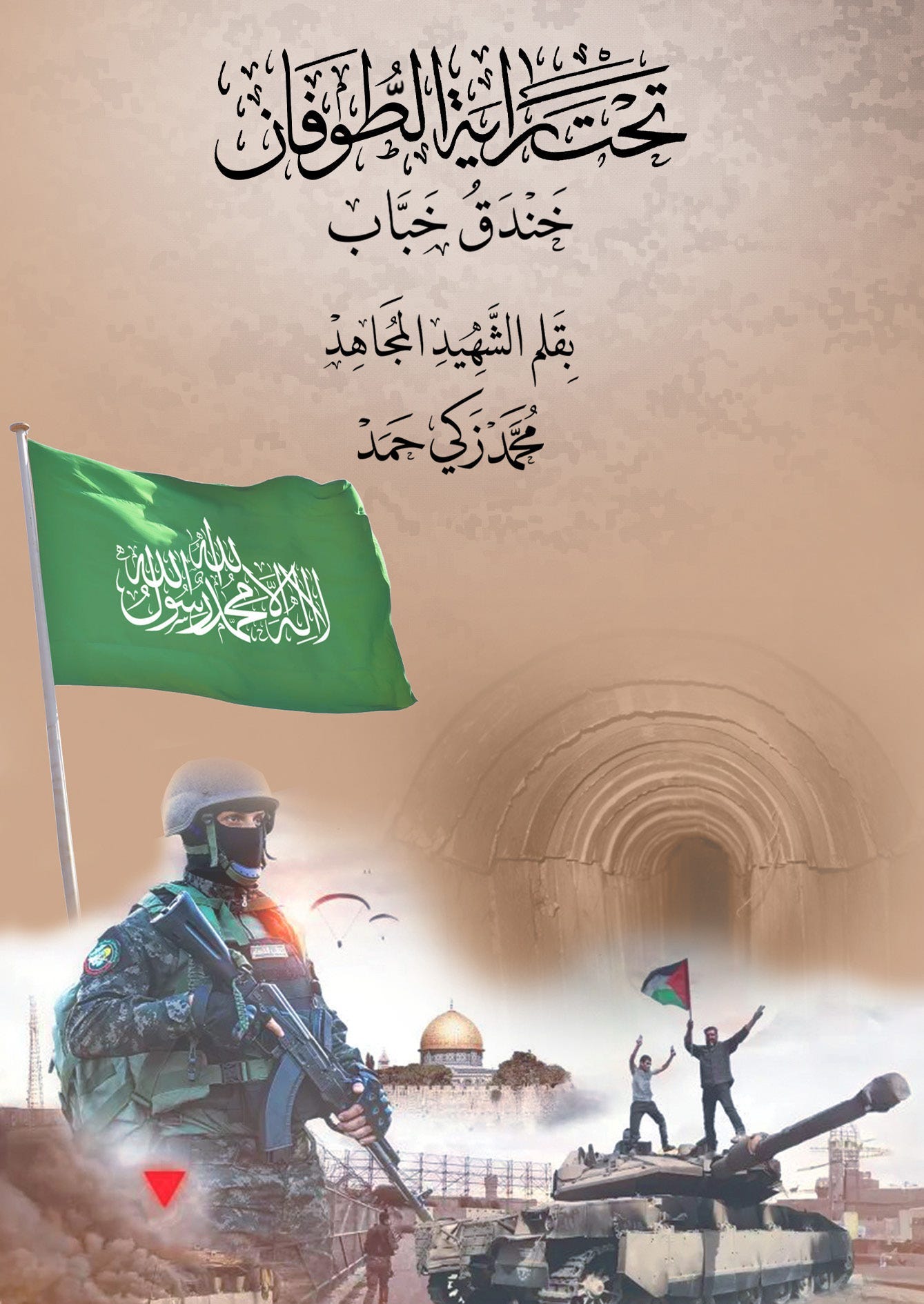
]( Hamas published Under the Banner of the Flood on the second anniversary of Tufan al-Aqsa. The martyred writer, Muhammad Zaki Hamad, was an Izz al-Din al-Qassam Brigades commander from Beit Hanoun. The work, which was authored between battles, dovetails the commander’s reflections on conditions in the combat zones with Qur’anic exegesis. This is Part Four of an ongoing translation effort. It details several important operations, including the targeting of the al-Shifa Complex and the resistance’s means of survival on meager rations. The following translation has been produced with care and deliberation. It has not made use of machine translations, contra the extant English translations that I have encountered, all of which elide Hamad’s intended meaning and traffic in clumsy appellation (to say nothing of the misrendered Qur’anic references). Although producing these translations takes significantly more time and labor, I hope readers will appreciate the qualitative difference. For readers who have not read the antecedent parts (which is by no means a prerequisite for making sense of the sections translated below, as they are self-standing), kindly see: Expand article✹ Defeating the Enemy ✹ Many people believe that the resistance in Gaza is preventing the enemy from advancing and penetrating deeper, and that it is capable of completely destroying it. This stems from a lack of military experience and knowledge [1], and from a misunderstanding of the historical experience of wars and battles. Praise be to Allah, we are not religiously obligated to destroy the enemy. Rather, we are obligated to prepare and repel it as much as possible, and Allah will not hold us accountable if we fail to destroy it completely. What matters is responding to Allah’s command to prepare and strive in His cause. The Battle of Tabuk was the greatest of Islam’s campaigns because it distinguished the ranks between believer and hypocrite. When three men stayed behind from the expedition, the Prophet ﷺ punished them severely, even though no fighting or combat took place at Tabuk. Allah wants us to respond to Him. The Exalted said: “O believers! Shall I guide you to an exchange that will save you from a painful punishment? ˹It is to˺ have faith in Allah and His Messenger, and strive in the cause of Allah with your wealth and your lives. That is best for you, if only you knew. He will forgive your sins and admit you into Gardens under which rivers flow, and splendid homes in the Gardens of Eternity. That is the ultimate triumph. And ˹you will receive˺ another favour you love: help from Allah and an imminent victory. Give good news to the believers.” [Qur’an 61:10–13] The meaning is this: strive and act righteously in the cause of Allah, for the sake of Allah, for the forgiveness of sins, and so that you may attain the ultimate triumph on the Day of Resurrection. As for military victory and defeating the enemy, that is another matter, and it ranks below the ultimate triumph. There were dozens of times when the mujahideen went out to carry out missions that were never completed. Sometimes there was a malfunction in the launcher, sometimes a defect in the projectile. We took every possible measure, yet Allah did not will for the projectile to fire. At other times, the drone could not reach its target. We would become deeply saddened. I saw some of the mujahideen weep bitterly. Once, my companion became so angry that the veins in his neck swelled because the explosive device failed to detonate. I consoled him and told him that his reward has not yet been decreed in full. Nothing in my words should be understood as a call to neglect preparation for battle. On the contrary, every instrument of war must be prepared and honed and without interruption. But if Allah does not decree that you kill or defeat the enemy, “You ˹O Prophet˺ have no authority over whether Allah turns in mercy to them or punishes them. They are truly wrongdoers.” [Qur’an 3:128] This will neither harm you nor reflect poorly upon your character. So long as we respond to Allah’s command, we remain upon goodness, with Allah’s help. Moreover, through a single arrow, three people may enter Paradise, as the Prophet ﷺ said: “Indeed, Allah will admit three people into Paradise because of one arrow: the one who makes it, seeking reward for making it; the one who shoots it; and the one who hands it to him.”(1) Yet there is a hidden allure in shooting, and whoever has experienced it knows this well. That is why people compete over it and eagerly seek it out. It is the culmination of one’s efforts, the core of our pursuit, and the arena in which strength and ingenuity are displayed. But with Allah, what matters is not desire, but intention. Jihad, ultimately, consists in intention. The one who fashions the weapon may surpass the one who fires it, and the one who carries or transports the weapon may receive the greatest reward of all. So direct your attention toward intentions, for they are what Allah looks upon. None of this should be understood as discouraging shooting itself. Rather, it is the kind of competition that is worthy of praise. Allah is the One who guides the shot and grants success. [1] From a military standpoint, the capabilities they possess are, with Allah’s help, sufficient to obstruct the enemy, delay it, and wear it down. They do not possess the military capability to annihilate and crush it completely. ✹ The Siege of Al-Shifa Hospital (The Miracle of Deception) ✹ From the very beginning of the battle, the enemy propagated the claim that Al-Shifa Hospital served as a command center for the resistance and contained weapons depots and tunnel entrances. This was a familiar lie, one our brothers in Iraq had already witnessed during the American invasion, which operated according to the principle: “Lie and lie until the masses believe you.” [1] The enemy entered the hospital, stormed it, and found nothing. It then withdrew and returned to its staging areas. Later, during Ramadan, on one of the nights, enemy forces quietly and suddenly infiltrated Al-Shifa Hospital, surrounding everyone inside and around it. A number of the brothers were there, along with thousands of civilians who had taken refuge in the area after the enemy destroyed their homes. The enemy arrived with overwhelming firepower, encircled the hospital from all sides, and struck one of the buildings with an F-16 missile. The Zionist commander leading the operation began shouting through a loudspeaker: “Everyone surrender! You are surrounded!” Unfortunately, some of those present surrendered, and they are now in detention, may Allah grant them patience and strengthen their hearts. When news broadcasts began reporting that the enemy had arrested some of the brothers and released their photographs, we were overcome with deep anguish. At that moment, I prayed that Allah would fill my heart with certainty so that I would not falter. Then I said to myself: if I were to fall, I would harm no one but myself. “And he who turns back on his heels will never harm Allah at all.” [Qur’an 3:144] There was no path before us except steadfastness and certainty. [1] America’s strategy during the Iraq War relied on the use of falsehoods to achieve its aims. A detailed discussion of this issue appears in my master’s thesis, “Media Values in Qur’anic Discourse,” Chapter Four. See also Michael Otterman’s book Erasing Iraq. As the story unfolded, some people I knew were inside the hospital, including a respected brother who had helped found the military wing in our city. He had been undergoing surgery there and would have recovered and gone home had the hospital not been stormed. Instead, he endured a fifteen-day siege as the area came under relentless shelling with some of the heaviest munitions used in the assault. After God spared him, I sat with him and listened as he chronicled all that had transpired. Hearing his account only strengthened my conviction that we can neither have peace nor compromise with the enemy, and that holding firm to steadfastness was the only correct decision in this scenario. From the moment the hospital complex came under siege, our brother had only a personal handgun and a few light weapons that several of the men inside had managed to bring in before the siege completely closed around them. There were eleven men altogether. They made a pact among themselves: “We will never surrender, no matter how intense the siege becomes. We will fight to our final breath, and we keep our grenades ready for the last moments of close combat. Whatever happens, we will not surrender.” The Zionist commander leading the operation tried to break them psychologically. Over the loudspeaker, he kept calling out: “Surrender yourselves. Don’t think you’re heroes.” “We’ve spoken to our higher chain of command, and you’ll be treated well if you surrender.” “A deal will be reached soon, and you’ll walk out as part of it.” “We’re not leaving until you surrender. We have nowhere else to be.” The same routine continued day after day. Meanwhile, the brothers stayed barricaded inside the burned-out building with no food and almost no water. For fifteen days, they survived on only a few drops of water a day, no more than half a small cup from morning to night. The Zionist commander shelled the building with incendiary rounds until it was completely engulfed in flames. The brothers climbed to the roof to breathe some fresh air, but they were struck by a missile fired from an aircraft overhead. One of the brothers was wounded and began bleeding heavily. With no medical equipment available, the others treated him as best they could with basic first aid. The pain became so severe that he considered giving up, but the brothers persuaded him to hold on. He endured, and God saved him. The Zionist commander was cunning. One day he called out to them: “I’ll count to ten for you to surrender yourselves,” and then began counting down: “10, 9, 8, 7, 6, 5…” all the way to “1.” Once he finished, he unleashed every kind of weapon they had against the fighters, including incendiary shells, anti-fortification rounds, heavy gunfire, and more incendiary shells. Yet our men remained steadfast and, by the grace of God, unharmed. Can you imagine an entire army unable to storm a building defended by only eleven men armed with little more than a handful of bullets—even after pummeling the building with copious rounds of bombardment and having burned it to the ground? Despite these conditions, our heroic men persevered, confronting their mendacity head-on. The Zionists sent in a quadcopter drone to film the site, inspect what had happened inside the building, and confirm whether everyone inside had been killed. The drone moved down the corridor, its propellers whirring loudly and its beams illuminating the pooling darkness. As it approached, one of our brothers quickly grabbed a shovel handle and struck the drone, smashing it apart before taking its lights and memory card out. The bombardment soon resumed with renewed intensity. The Zionists fired an F-16 missile at the elevator shaft, badly injuring and petrifying the brothers, but still they survived. After nine days of patiently waiting, deliberating, attempting to negotiate, and severe shelling, the occupation army swarmed into the building. The enemy forces surged through the corridors only to meet the brothers, who quickly fired upon them. With his weapon still in hand, one of the brothers grabbed a grenade. He stealthily pursued the soldiers, and, having located them, hurled it at them. After that, the soldiers never returned to the building. But the siege and shelling continued for another fifteen days. On the fifteenth day, the wounded and exhausted brothers trapped inside suddenly heard faint voices of our compatriots outside. At first, they could not believe it. Finally, one of them gathered the courage to step outside and see what had happened. He discovered that the occupation army had withdrawn. Yes, it had truly withdrawn. There was not a trace of the army left in the area. Can you imagine that? As they emerged, they found crowds of people searching for their relatives. The treacherous enemy had executed people in the hospital courtyard and buried them alive in mass graves. The brothers, desperate for medical treatment, food, and water, then turned to caring for their wounds. They were suffering from numerous illnesses, severe malnutrition, and emaciation. Their body weight had fallen by half, yet they were still alive by the grace of God. Later, they sat with us and recounted everything they had endured. Their survival was a miracle born from struggle. Indeed, it was a reward borne from steadfastness. They have now recovered from all the pain and suffering they endured, and today they are back once more in the trenches of the mujahideen, God willing. Afterward, the enemy opened an investigation into how eleven men, including figures holding high military ranks, managed to emerge alive from the al-Shifa compound after everything they had subjected them to. May God protect our men, and may He never cut us off from His support and aid. ‘Allah’s Will always prevails, but most people do not know.’ [Surah Yusuf 12:21] ✹ An injured elderly man (“Our blood is worth more than theirs”) ✹ Enemy vehicles started advancing toward the area of resistance operations. Alerted, our mujahideen brothers mobilized to carry out their mission. As they prepared to execute an ambush, they suddenly came across an elderly man wounded in the foot and unable to move. Meanwhile, the enemy vehicles were drawing closer and closer to his position. The brothers were waiting for the enemy to enter the ambush point so they could strike and withdraw. But what would happen to this helpless old man? They immediately informed our commander of the situation. Without hesitating, he assuredly responded: “Call off the operation and save the man.” “Call off the operation? The enemy will reach the ambush point within moments!” But he firmly repeated the order: “Stop the operation and save the wounded man. Our blood is worth more than theirs. The point of jihad is to save lives.” Taking cover, the brothers called out to the man, “Uncle, crawl toward us!” Enemy reconnaissance aircraft were circling overhead, but the old man managed to heave himself forward, crawling inch by inch. Soon enough the brothers reached him, heaving him to safety. They then lowered him into the tunnel. He was stunned, unable to comprehend what was happening. Our commander later arrived and carried the man himself. This scene reminded us of the humanity behind our struggle. He informed the brothers, “There is more honor in saving a life than in killing those pigs.” The brothers treated the man with a first aid kit and delivered him to a safe location. This was an exhausting task given the rough terrain and condition of the tunnels. He had escaped near-certain death and remains alive today. By the grace of God, the enemy withdrew from the area the following day without harming a single person. This was truly a blessing. Perhaps the old man’s prayers had something to do with it. Afterwards, the man recounted this story to his children and family. In turn, they replied, “There is no power and no strength except through God. You’ve lost your mind!” As a further act of kindness, our commander sent the man a sum of money to help ease his situation. Imagine—these are the mujahideen whom some maliciously accuse of shedding innocent blood. In truth, the resistance has been entrusted with protecting our people’s lives and property. These are the men who guard over the land and its honor. May God guide our commander, protect our men, and bless us with sincerity and acceptance before Him. ✹ Fresh Water ✹ As the battle dragged on, the enemy destroyed the entire water network. A single sip became something for which people would trade their very lives. Not a single house in the town had even a bottle of water left. Who could have imagined that the most coveted thing a person could wish for would be a meager sip of water? At one point, one of the brothers was tipped off that there was a house with a water tanker carrying roughly five thousand liters of water, buried beneath a bombed-out building. Good, they thought, we’ll try to reach that tank and draw water from it. But the situation before us was precarious to say the least. The town, which was on the border, had been entirely deserted. Consequently, the enemy has spread itself throughout the area. When they attacked, the mujahideen would fastidiously strike and then expeditiously retreat back into the tunnels. Any visible movement would immediately draw intense aerial bombardment. Worse still, the tunnel entrance they normally used was far from the water tank. So what could be done? Well, there was another tunnel entrance close to the tank, but it had been struck by an F-16 missile and was completely destroyed. After much thought, they reached a decision. The brothers would excavate the derelict tunnel shaft, repair it, and use it to draw water from the tank into the tunnels. The obstacles, however, were immeasurable. On the one hand, they had no machinery. On the other, their bodies had grown enfeebled from hunger and thirst, precipitating their languishment. A person can survive three days without water and forty days without food, but without resolve, he cannot endure life for even a moment. Yet the brothers began digging, unearthing the tunnel entrance using the most primitive of tools. Soon they came across massive rocks. They looped long ropes around the rocks and pulled them from deep inside the tunnel until the rocks finally cracked and broke apart, just as the rock once split apart beneath the Prophet’s hands during the Battle of the Trench. Their arduous efforts continued until the shaft was finally reopened. Glory be to God, what a blessing and mercy it was. At last, the mujahideen could pump water from the tank down into the lower tunnel. The water was clean and fresh. At a time when water throughout the entire region had become scarce or disappeared altogether, God, by His grace, provided the mujahideen with fresh water. The road to Paradise is onerous, but, with patience and steadfastness, one will eventually be led to a place unmarred by thirst, fear, or distress—”And indeed, you will not be thirsty therein or be hot from the sun” [Taha 20:119]. In those moments, the brothers’ hearts seemed to bespeak: “My Lord, just as You gave us fresh water to drink in this fleeting world, grant us the day when ‘their Lord will give them a purifying drink.’” [al-Insan: 21] ✹ Water Gushing from the Earth ✹ Water was indispensable. As the battle dragged on, constantly transporting water became an enervating task for the mujahideen, compounded by the magnified dangers of moving back and forth along enemy lines. What they needed was a nearby water source, one located inside the tunnels themselves. This would meet the fighters’ needs and safeguard them from another water shortage. The brothers began searching through the tunnel passages and eventually discovered an old well pipe running alongside one of the tunnels. We decided to follow the pipe’s path and began digging alongside it, deeper and deeper into the earth, hoping it would eventually lead us to the underground water source that could be canalized throughout the tunnels. The work continued around the clock for two whole days. By God’s grace, they finally broke through and reached the water source. They brought in hoses and ran them through the tunnel network. Before long, water was flowing through the tunnels once again, praise be to God, and tanks were filled for each group of mujahideen. I sat there thanking God for His help and provision, and we said: “Even the simple act of purification had become a blessing to us.” I remembered how God blessed His Prophet ﷺ by causing water to flow from between his fingers so the mujahideen could drink. In the same way, water burst forth for us from deep within the earth. We drank until our thirst was quenched and, following a protracted period, were able to wash our bodies. Glory be to the One who gives life and causes death, and to whom all things return. Miracles and divine blessings never cease, though they appear in different forms. We never doubted that God, generous as He is, would continue to provide for His servants and never cut them off from His sustenance. May God have mercy on the one who said: “When you recognize your own limitations, He sustains you through His perfection. When you recognize your poverty, He sustains you through His abundance. When you recognize your weakness, He sustains you through His strength.” [1] Al-Bukhari narrates from Anas, may God be pleased with him: “I saw the Messenger of God ﷺ when the time for the afternoon prayer had come. The people searched for water for ablution but could not find any. Then water was brought to the Messenger of God ﷺ. The Prophet ﷺ placed his hand in the vessel and instructed the people to perform ablution from it. I saw water gushing from between his fingers until every last one of them had performed ablution.” Abu Hamza ibn Abdullah asked, “How many people were there that day?” He replied, “We were fifteen hundred.” Also narrated by Imam Ahmad, hadith no. 3807. ✹ Enemy Provisions ✹ By closely monitoring the minutiae of the enemy’s conduct, we came to appreciate just how heavily they relied on vast logistical networks that kept the occupation soldiers constantly supplied with food, water, and every other necessity. The nature of the war, along with the vast imbalance in resources, allowed them to maintain land, sea, and air supply lines with ease. Meanwhile, the mujahideen survived on a few canned goods and meager sips of water. As we watched trucks and military vehicles deliver crates of food to them, all we could say was: “O God, make it poison in their bellies and blood upon their hands.” At one point during the fighting, the enemy forces established a position near the entrance to one of our tunnels. They began transporting large quantities of food and water there, unaware that a tunnel ran beneath the perimeter. The mujahideen focused their operations on specific combat sectors where attacks on the enemy were being carried out, while the remaining sectors were used for surveillance, monitoring enemy movements, and moving between positions. Since the enemy’s supply depot lay far from the combat sector assigned to us by the battalion leadership, we began devising means by which we could reach the food without creating noise or movement that might expose our location. So we watched the area meticulously. Then the moment arrived. The enemy forces were distracted by activity in other sectors. As their attention was fixed elsewhere, the mujahideen prudently seized the opportunity, surreptitiously slipping into the supply area and quickly carried off large quantities of food that we had not seen since the beginning of the war: water, fruit, vegetables, nuts, juices, pastries—an array of mouthwatering foods, praise be to God. Do you appreciate what transpired? Their kitchens had prepared the food, measuring out portions according to the number of soldiers, and packing everything before military vehicles hauled it across long distances from inside our occupied lands into the center of our city. There, they unloaded it and stored it as provisions to sustain their ongoing crimes. Yet despite all this, destiny had already decreed that this food belonged to the mujahideen. God made the occupation the very means through which we were nourished, with food that sustained us for many days. The disbeliever, blind as he is, never sees how destiny can make him serve the very people he seeks to destroy. This is only one small example of the occupation’s foolishness, where their falsehood unknowingly bears fruit for those fighting for truth: “That is Allah—your Lord, Creator of all things. There is no god worthy of worship except Him. How can you then be deluded?” — Surah Ghafir: 62. |
||
| 1 Original | |||

| Post Reply |
Back to top |