| Post Reply | RetroFed Forum Forum Index » Saturday Morning Breakfast Cereal |
| Author | Message | ||
|---|---|---|---|
 m_f
discuss.online
m_f@discuss.online Joined: 2024-12-11 |
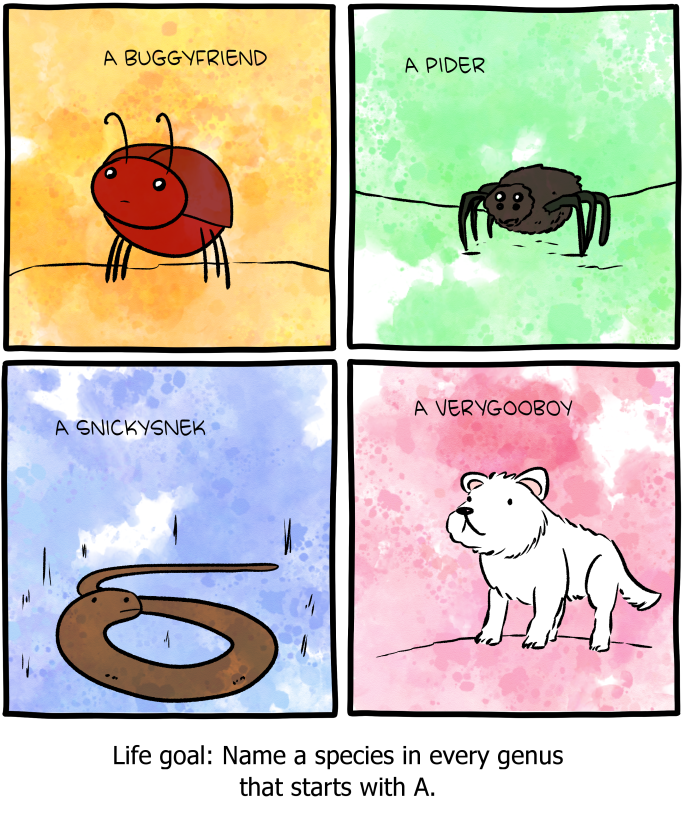
http://www.smbc-comics.com/comic/a-2 Alt textBonus points if you can figure out what the canine is. Bonus panel
|
||
| 39 Original | |||
 Gladaed
feddit.org
Gladaed@feddit.org Joined: 2024-06-26 |
Arses is a genus of monarch flycatchers in the family Monarchidae. |
||
| 4 | |||
|
m_f
Moderator
m_f@discuss.online Joined: 2024-12-11 |
Last one might be this guy: https://en.wikipedia.org/wiki/Short-eared_dog
Doesn't really look like the drawing though:
Could also be Alopex lagopus, now known as Vulpes lagopus, i.e. Arctic Fox https://en.wikipedia.org/wiki/Arctic_fox
Much closer to the drawing, though it seems weird to draw the comic based on the old name |
||
| 1 | |||
|
DerisionConsulting
lemmy.ca
DerisionConsulting@lemmy.ca Joined: 2023-06-24 |
I am very surprised that this is from this year, and not 2016. |
||
| 3 | |||
|
m_f
Moderator
m_f@discuss.online Joined: 2024-12-11 |
Last one might be this guy: https://en.wikipedia.org/wiki/Short-eared_dog The short-eared dog (Atelocynus microtis), also known as the small-eared dog, short-eared fox or small eared zorro, is an elusive canid species endemic to the Amazonian basin. This is the only species assigned to the genus Atelocynus. Doesn't really look like the drawing though: Could also be Alopex lagopus, now known as ...
  Oh, might be Aenocyon dirus, a.k.a. the Dire Wolf The dire wolf (Aenocyon dirus /aɪˈnɒkaɪ.ɒn ˈdaɪrəs/) is an extinct species of canine which was native to the Americas during the Late Pleistocene and Early Holocene epochs (125,000–10,000 years ago). The species was named in 1858, four years after the first specimen had been found. Two subspecies are proposed, Aenocyon dirus guildayi and Aenocyon dirus dirus, but this assignment has been recently considered questionable. The largest collection of its fossils has been obtained from the Rancho La Brea Tar Pits in Los Angeles.
https://colossal.com/direwolf/ EDIT: Yeah, gotta be this, someone "resurrected" them a few years ago, which would work with the naming part of the joke: https://anatomypubs.onlinelibrary.wiley.com/doi/abs/10.1002/ar.70049
Very cute little guys:
|
||
| 1 | |||


| Post Reply |
Back to top |