| Post Reply | RetroFed Forum Forum Index » Nudibranchs |
| Author | Message | ||
|---|---|---|---|
 quinacridone
mander.xyz
quinacridone@mander.xyz Joined: 2024-03-29 |
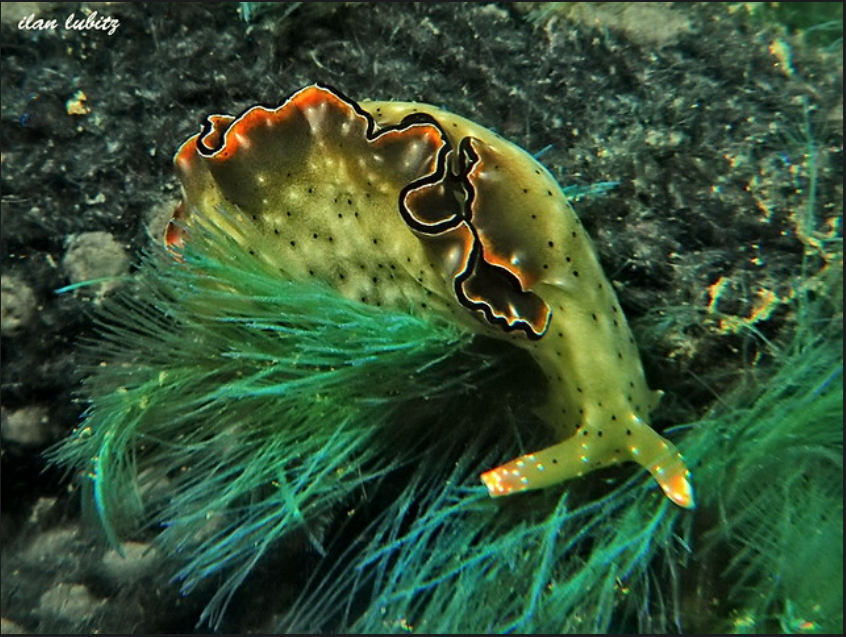
Main photo by ilan Lubitz Elysia marginata are Sacoglassons (a type of sea slug) and are found in the Indo-Pacific ocean at depths of 0-10 metres
Above photo by budak They eat algae and store the chloroplasts in its body. The chloroplasts continue to photosynthesize and provide its host with a source of food!
Above 'Pair of leaf slugs on algae. They feed on green algae and can grow from 3 to 8cm long. Photo by Wesley Oosthuizen.' source They have the ability to regenerate a completely new body (including a new heart) from their head, after it detaches itself from its old body! (A process called autotomy- self amputation)
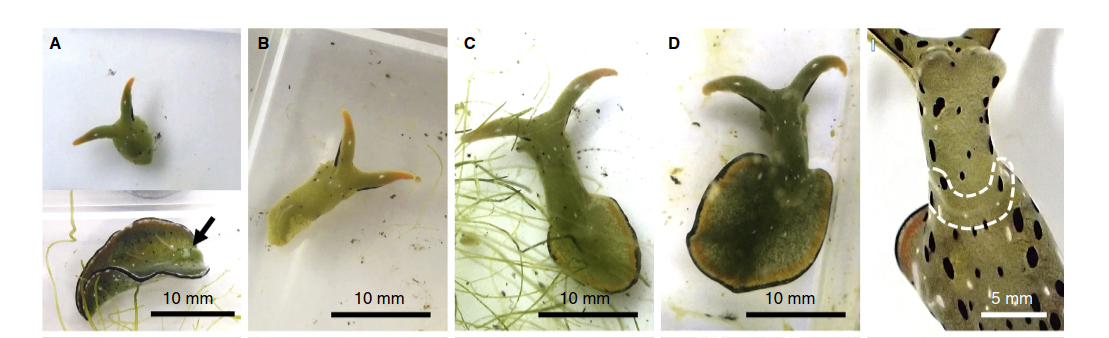
Above photo by Sonja Ooms Their ability was discovered by Sayaka Mitoh, a doctoral student at Nara Women's University in Japan, who spotted the decapitated head of E. marginata circling its separated body in one of the tanks in the lab
Above 'This image shows the head and the body of Elysia cf. marginata, a day after autotomy.' (Image credit: Sayaka Mitoh) source Quite naturally she thought the slug would soon die, however..
Above text and photo source The head continued to grow its new body over the next 3 weeks, including all vital organs, reaching about 80% of its original size!
Above gif source
The old bodies remained active for several days to months, until they started to shrink, turn pale due to the chloroplast loss, and eventually died. The beating heart remained visible until the body had fully decomposed! So, why such an extreme behaviour? In other animals self amputation usually occurs when escaping a predator, however this may not be the case here....
Above photo by budak The head can take several hours to detach from the body, so not exactly a quick get away from a predator Instead it is suspected that it is a means of ridding itself of parasites. There is a slight groove towards the end of the head which acts as a breakage plane, and the similar head severing species Elysia atroviridis all had internal parasites when they detached from their bodies.... However, no parasites were detected in Elysia marginata that did the same.....
Above photo by Javier Diaz Frogmen The ingested chloroplasts are thought to help in the regeneration of the new body and keep the head alive in the absence of the digestive system organs (which remain with the body). One individual that was studied underwent autonomy and regeneration twice, which researches think is the limit...(which probably means it didn't survive the third time scientists went to work with a scalpel) Interestingly this behaviour was only exhibited by young Elysia marginata. When older animals were decapitated their heads survived up to 10 days, and didn't regenerate before dying
Above photo by Antonio Venturelli All information from wikipedia, here, here, here, here, here and here As always I'm not an expert, any errors let me know in the comments and I'll edit And I shall leave you all with a reprise of my current favourite gif....
|
||
| 1 Original | |||




| Post Reply |
Back to top |