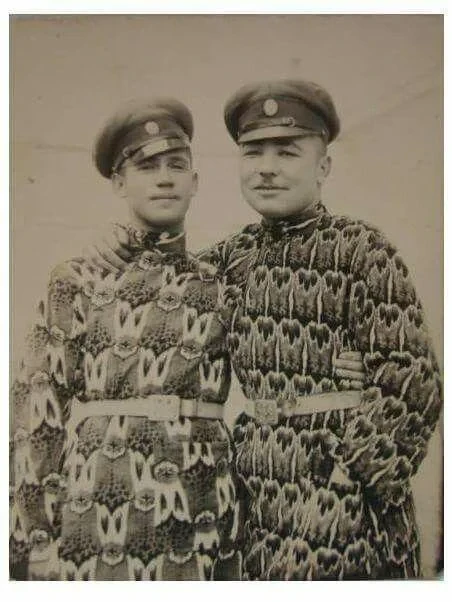
I don't know if that's a good form of camouflage, but if you look at Soviet uniforms in WW2, I don't think I remember seeing much use of camouflage at all. That has to be better than what was in use.
goes to hit up Camopedia
Yeah. Sounds like this amoeba stuff was specialized, for people who were in risky forward positions, like artillery observers. The stuff they have through WW2:
https://camopedia.org/index.php?title=USSR
The first mass-produced Soviet camouflage uniform was the makirovochnyi kamuflirovannyi kostium or MKK, printed with large reddish-brown amoeba shapes on a light green or khaki background. Introduced in 1938, the MKK (also issued as a one-pieced coverall or makirovochnyi kombinezon - MK) was in service with engineers, snipers, airborne forces, forward artillery observers and reconnaissance units throughout the Second World War. Coloration of the pattern varied depending on the factory that produced it, and there is sufficient evidence to suggest that specific color variants were produced for particular seasons or types of climate. Uniforms in this pattern continued in service sporadically for the next couple of decades, and even longer with reservists and cadets. [1] This camouflage design is often called Soviet "amoeba" pattern, and a derivative pattern was produced in East Germany a few years after the war.-


In 1941 a different type of camouflage design was introduced, utilizing a printed pattern of dark leaves & twigs on a khaki-colored field. Referred to in some period literature as letniy kamuflyazh (summer camouflage), surviving examples suggest the colored overprint was likely produced in at least two variations (green or grey/brown) for wear during different seasons. Some of these uniforms were, in fact, reversible from a green to a brown-dominant design. The issue uniform was the same MKK/MK type, and saw service well into the 1960s with some Soviet units. Following the Second World War, large stocks were given to Romania, where it became the only camouflage uniform in use until the 1990s. Not to be confused with ERDL-derivative patterns, this style of camouflage is also often called "leaf pattern," for obvious reasons.


Entering service later in the war (1944) was the tritsvetnyi makirovochnyi kamuflirovannyi kostium or TTsMKK uniform, printed in a unique three-color disruptive camouflage. It has been suggested that the pattern was developed by the Soviets to thwart German infared night vision devices that began appearing in early 1944. The overlapping pattern of dark green and foliage green on a yellow-tan base incorporated a "stair step" concept that would classify many Soviet designs for years to come. As with the earlier uniforms, the same MKK/MK style uniforms were issued in this pattern, generally reserved for reconaissance, sniper & border units during the war and into the 1950s. This pattern was later exported to Albania where it served with their elite units into the 1990s. Contemporary variations have also been worn by Russian military forces in the 2000s.

Toward the end of the Second World War, a short-lived camouflage design emerged that combined "stair step" features of the TTsMKK with those of the original "amoeba" pattern. It was essentially the standard TTsMKK design with an overprint of brown amoeba shapes in the same style as the 1938 pattern. Several types of uniform in this pattern have been documented, and it apparently saw service between 1945 and 1950, although does not seem to be documented beyond that point. However, modern versions of the pattern have been documented in use by Russian military forces in the 2000s.

A variation on the "leaf" theme introduced with the letniy kamuflyazh appeared in the postwar period and is seen here. Very little information has appeared thus far concerning the production period, but it seems likely this design did not remain in production for a long period. This design may have been termed listopad kamuflyazh (falling leaves camouflage).

Of the images here, only the scouts have camouflage uniforms:
https://sovietuniform.com/soviet-ww2-uniforms-1943-1945/
 PugJesus
piefed.social
PugJesus@piefed.social
 tal
lemmy.today
tal@lemmy.today