| Post Reply | RetroFed Forum Forum Index » RoughRomanMemes |
| Author | Message | ||
|---|---|---|---|
 PugJesus
piefed.social
PugJesus@piefed.social Joined: 2025-03-24 |
|
||
| 15 Original | |||
|
PugJesus
Moderator
PugJesus@piefed.social Joined: 2025-03-24 |
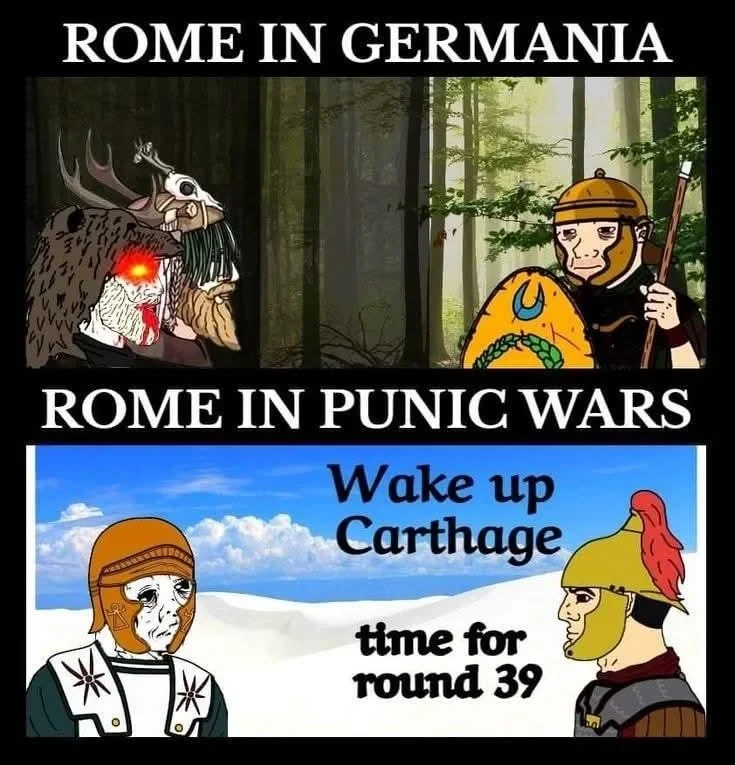
Explanation: The Roman Republic was often noted for its... gruesome sense of determination, and long-lasting grudges. While the polity was not wholly democratic, it did involve significant input from the population, which encouraged government policy to reflect, if not necessary the concerns of the Roman population, at least the values of it. As such, wars and policy needed to align with at least a compelling argument of why they were important to receive continued approval by the People's Assemblies. Most famously, in the Punic Wars, the Roman Republic endured repeated and massive losses in the name of overcoming a rival who initially appeared to be a genuine threat (in the Third Punic War, it was purely a grudge match). In the First Punic War, hundreds-of-thousands of troops were lost before Rome emerged victorious. In the Second Punic War, some 80,000 troops were lost in a single defeat, and Rome's decision was to double-down on the prospect of winning the war for the next 15 years. However, the Roman Empire does not evince quite the same sense of stubbornness. As all effective power had been transferred to the Emperor (who was not a democratic position) and the Senate (which was never fully democratic, but also certainly not the most democratic of the institutions of the old Roman Republic), they had more 'leeway' to conduct affairs 'rationally'. By both the fact that the Roman Republic's determination was in part a function of its irrationality, and the iron law of institutions ("Institutions make decisions in the interest of the decision-makers, not the institution" - and a loss during a war is more politically damaging to the decision-maker than the institution), wars became much less likely to devolve into prolonged attritional struggles that Rome won out of sheer, bloody-minded stubbornness. Most famously here, a single loss in Germania during the Early Empire - the Battle of Teutoburg Forest - of some ~15,000 men decisively ended Roman expansion into Germania indefinitely. |
||
| 10 | |||
|
nova_ad_vitum
lemmy.ca
nova_ad_vitum@lemmy.ca Joined: 2023-07-06 |
Explanation: The Roman Republic was often noted for its... gruesome sense of determination, and long-lasting grudges. While the polity was not wholly democratic, it did involve significant input from the population, which encouraged government policy to reflect, if not necessary the concerns of the Roman population, at least the values of it. As such, wars and policy needed to align with at lea...
There are a lot of videos of the Battle of Cannae. This one is pretty good. |
||
| 3 | |||
| Post Reply |
Back to top |